Why Poland is becoming a benchmark for the European residential market
18 / 03 / 26
2 min
Why Poland is becoming a benchmark for the European residential market
In recent months, Poland has been steadily strengthening its position as one of the most attractive residential markets in Europe. At a time when construction costs in Germany are rising and regulatory complexity increasingly limits the feasibility of new developments, the Polish market is attracting developers and investors with greater predictability, more efficient processes, and a more favorable cost structure.
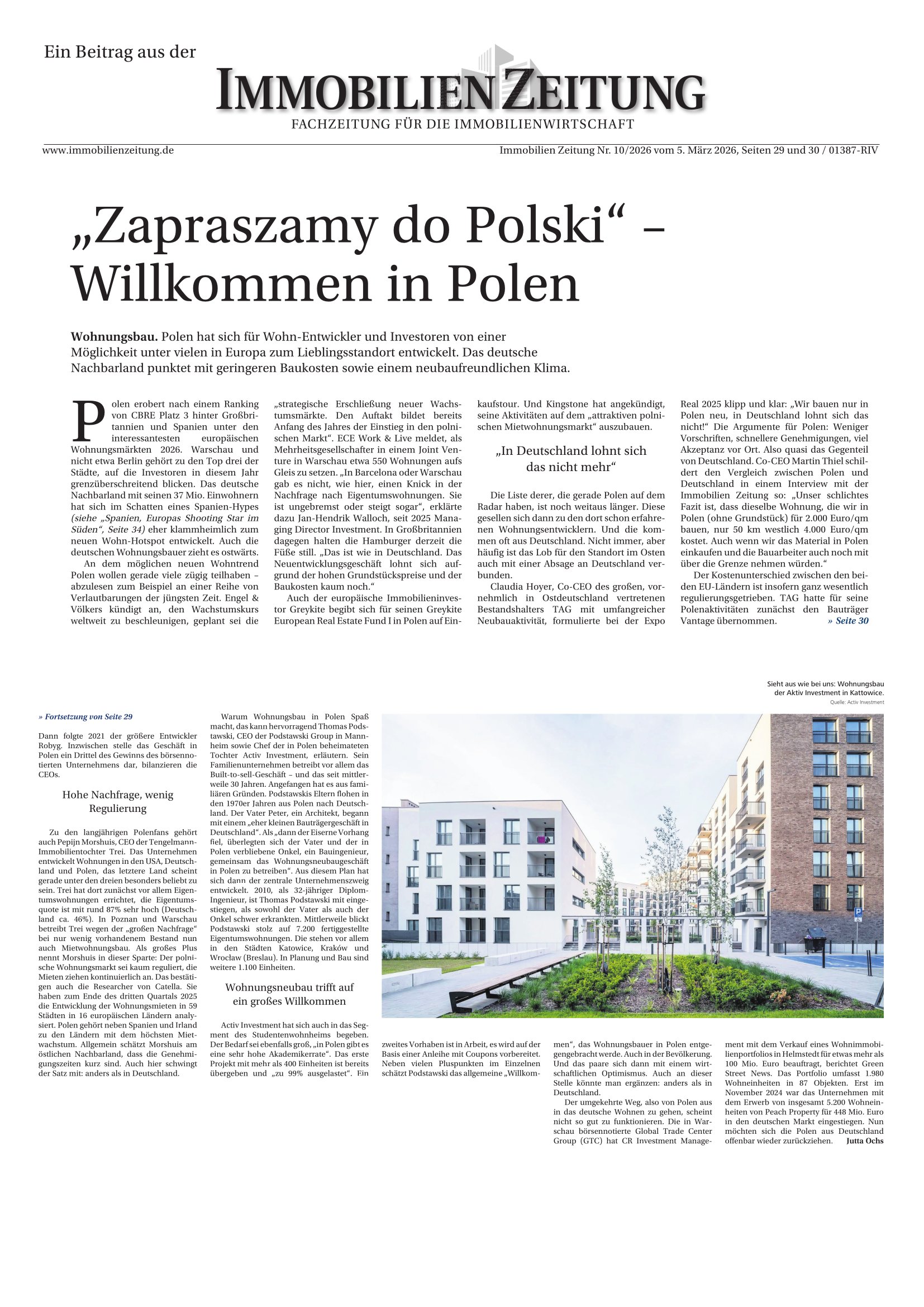
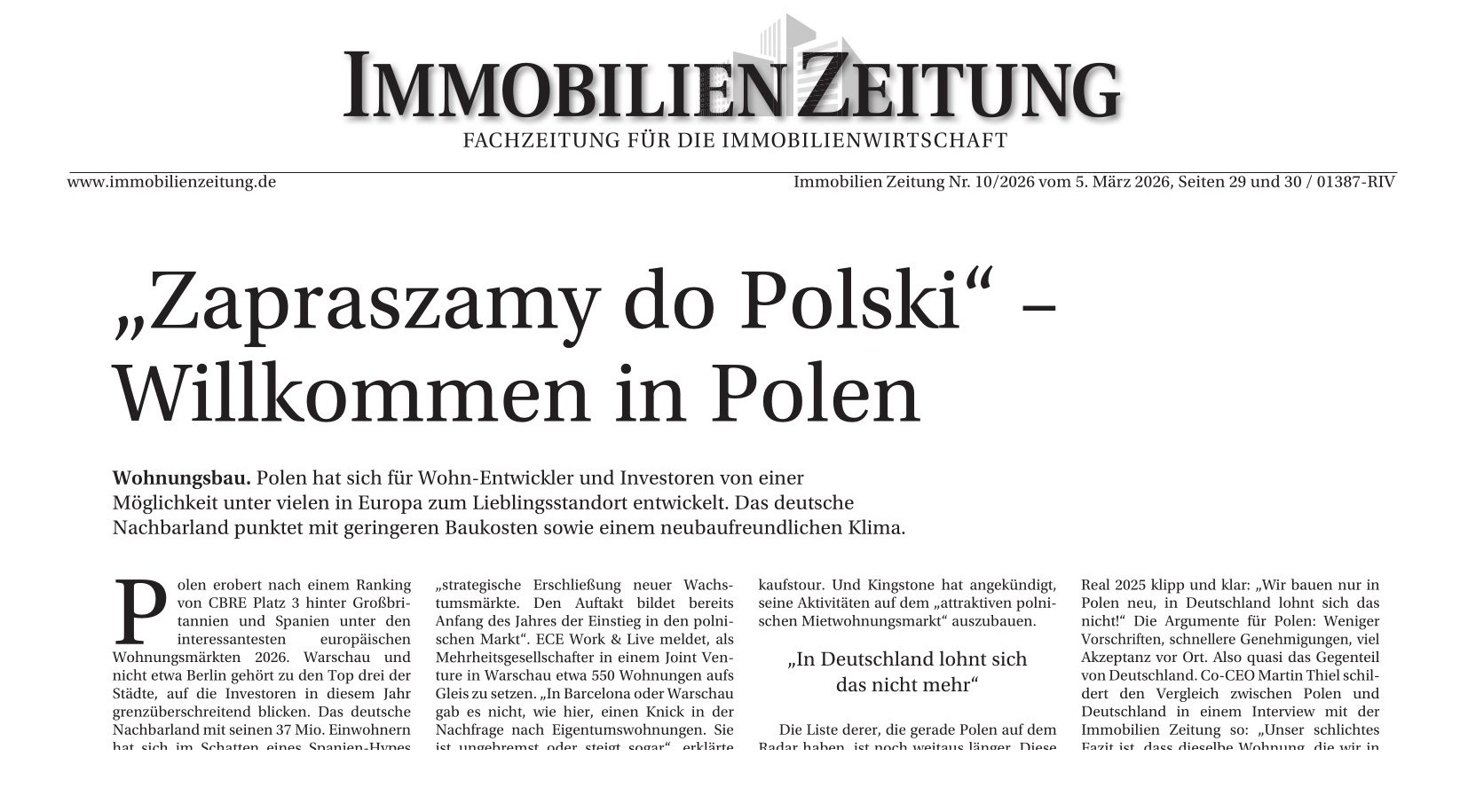
This topic has recently received widespread coverage in the German trade media. The prestigious magazine *Immobilien Zeitung* has published a highly interesting article entitled *Willkommen in Polen*. In this article, Thomas Podstawski, CEO of Activ Investment, explains in detail why Poland has become such an attractive destination for Western capital.
Lower costs and stronger investment fundamentals
One of the key arguments lies in project economics. Industry analyses indicate that construction costs in Poland can be up to 50% lower than in Germany. This difference directly impacts project profitability, speed of execution, and the overall scale of development activity. At the same time, housing demand in Poland remains strong, with continued growth across selected segments.
Expert insight: Thomas Podstawski on the advantages of the Polish market
A particularly valuable perspective comes from market practitioners who have been actively developing residential projects in Poland for years. Thomas Podstawski, CEO of Podstawski Group and President of Activ Investment, consistently highlights the long-term potential of the Polish market. The Group has already delivered over 7,200 residential units in major Polish cities, with further projects currently in preparation and under development.
In the article “Willkommen in Polen”, published in Immobilien Zeitung, Thomas Podstawski explains why Poland is increasingly at the center of attention for European residential investors. He points to key advantages that are highly relevant today: lower construction costs, more efficient administrative procedures, shorter permitting timelines, and a more supportive investment environment.
From an operational perspective, the Polish market stands out clearly. Fewer regulatory barriers and more efficient development processes not only enable faster project delivery but also support scalability. For companies with a long-term strategy, these factors are of fundamental importance.
Growing potential in emerging segments, including student housing
Thomas Podstawski also highlights the growing importance of new market segments, particularly student housing. A high share of university graduates, the expansion of academic hubs, and increasing mobility among young people contribute to stable demand for this type of asset. This is further confirmed by projects achieving near-full occupancy at an early stage of operation.
A strong example is the ZEITRAUM student residence in Cracow, developed by Activ Investment under the leadership of Thomas Podstawski, which clearly demonstrates the potential of this segment in the Polish market. This experience provides a solid foundation for the company’s continued expansion into modern student housing projects tailored to the evolving needs of young residents and investors.
A resilient market in a dynamic environment
Poland is, of course, not without challenges. Greater sensitivity to interest rate changes and more dynamic market cycles require conscious and well-managed risk strategies. Nevertheless, the combination of a more favorable regulatory environment, relatively lower construction costs, and sustained demand positions Poland as a viable alternative to many mature European markets.
A market setting new standards
The conclusions are clear: Poland is not only attracting international capital but is increasingly becoming a model for how to create conditions that support residential development. Today, competitive advantage is defined not only by numbers, but also by execution speed, predictability, and the ability to deliver projects effectively. These strengths are building Poland’s position as one of the most attractive residential investment markets in Europe.